
Norway
November 25, 2026

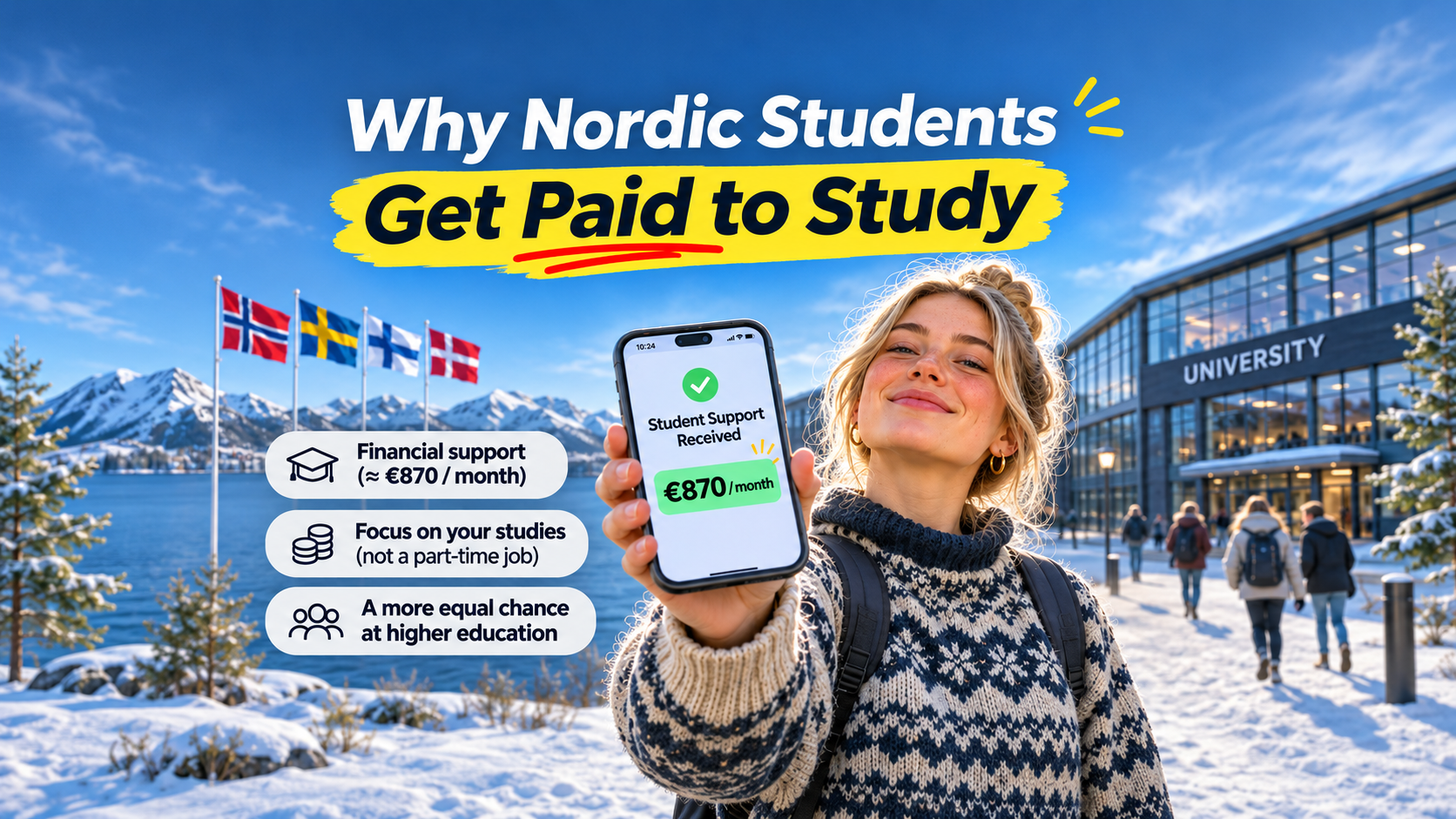
Free university, government money and a surprisingly sensible explanation.
Imagine telling an American university student:
“Not only is your university education free, but the government might actually pay you to study.”
They would probably laugh. Then ask what the catch is. Then immediately start Googling flights to Copenhagen.
But in the Nordic countries, getting financial support to attend university is perfectly normal.
No wealthy uncle required. No winning lottery ticket. And no need to spend the rest of your working life paying off your education.
Student loans are available if you want them, but going into debt isn’t a requirement for getting a university degree.
Just a society that considers education an investment rather than an expensive personal hobby.
And while the five Nordic countries have different approaches, they share one important idea: Your family’s bank balance shouldn’t determine your educational future.
Denmark takes student support rather seriously.
Eligible university students receive SU (Statens Uddannelsesstøtte), a monthly government grant that doesn’t normally have to be repaid.
In 2026, students living away from their parents can receive DKK 7,426 (approximately €995) per month before tax.
Yes, actual money. Every month.
Tuition is also free for Danish, EU/EEA and Swiss students at public universities.
Of course, Copenhagen rent has a remarkable talent for making money disappear. But that’s another story.
The official Danish SU system explains how it works.
Sweden follows a slightly different formula through CSN, its student finance system.
Eligible students can receive a government grant and choose to supplement it with a student loan.
In 2026, a full-time student can receive SEK 4,120 in grants over four weeks, plus an optional loan.
The idea is simple: provide financial support today, then repay the borrowed portion when you’re earning.
It’s a very Swedish arrangement. Practical, organised and involving considerably less drama than assembling a wardrobe without instructions.
See the official Swedish student finance system.
Finland has built an international reputation around education, and its student support reflects that commitment.
Eligible students can receive a study grant, a housing supplement and access to government-guaranteed student loans.
The grants are generally smaller than Denmark’s, but housing assistance helps with one of student life’s greatest challenges: finding somewhere affordable to sleep between exams.
Finland’s Kela student support system explains the details.
And if you’re curious why Finnish education attracts so much attention, read our story about Finland’s famous education system.
Norway has a particularly interesting arrangement.
Through Lånekassen, eligible students receive financial support initially structured largely as a loan.
But here’s the clever part: up to 40% of the basic student loan can be converted into a grant if students meet the conditions, including academic progress, degree completion, living arrangements and income limits.
Essentially, Norway says: “We’ll help finance your studies, and if you meet the requirements, you won’t have to repay everything.”
That’s rather encouraging.
You can explore the Norwegian student loan and grant rules.
Iceland also believes in accessible education, but its financial support works differently.
Public universities generally don’t charge tuition fees, although registration fees apply. Student financing relies mainly on government-backed loans rather than universal monthly study grants.
So Iceland doesn’t quite follow Denmark’s “Here’s your monthly money” approach.
Then again, studying on an island with volcanoes, glaciers and geothermal swimming pools has certain advantages.
Learn more about Iceland’s student loans.
Because educated citizens are valuable.
Doctors, engineers, teachers, scientists and entrepreneurs don’t magically appear when a country needs them.
Education costs money, but so does having a workforce without the skills society needs.
Nordic governments therefore invest heavily in education, aiming to create long-term benefits through productivity, innovation and future tax revenues.
It’s part of the wider Nordic economic model, where public services, taxation and social trust are closely connected.
The government isn’t simply handing out free money. It’s investing in people.
And those people will hopefully become taxpayers.
The Nordic circle of life. With considerably more paperwork than Disney’s version.
Not quite.
Tuition-free education and financial support are two different things.
EU/EEA students can often study without tuition fees, but receiving government student grants usually requires meeting additional citizenship, residency, employment or other eligibility conditions.
Students from outside Europe may also face tuition fees, depending on the country and programme.
And while loans are optional, grants alone won’t necessarily cover every living expense.
So booking a one-way flight to Oslo and declaring yourself a philosophy student isn’t necessarily a retirement strategy.
Nordic university cities offer a fascinating glimpse into the region’s priorities.
From Copenhagen’s cycling students and Aarhus’ lively cafés to Stockholm’s historic academic atmosphere, Helsinki’s modern campuses and Oslo’s waterfront student life, education is woven into everyday culture.
At Best of Nordic, we arrange tailor-made journeys, educational tours, technical visits and cultural experiences that go beyond ordinary sightseeing.
Because understanding a country is often more interesting than simply photographing it.
Get in touch with Best of Nordic and discover the Nordic way of doing things.
And who knows? You might return home wondering why your own university never sent you a monthly thank-you payment.