Denmark
November 22, 2026

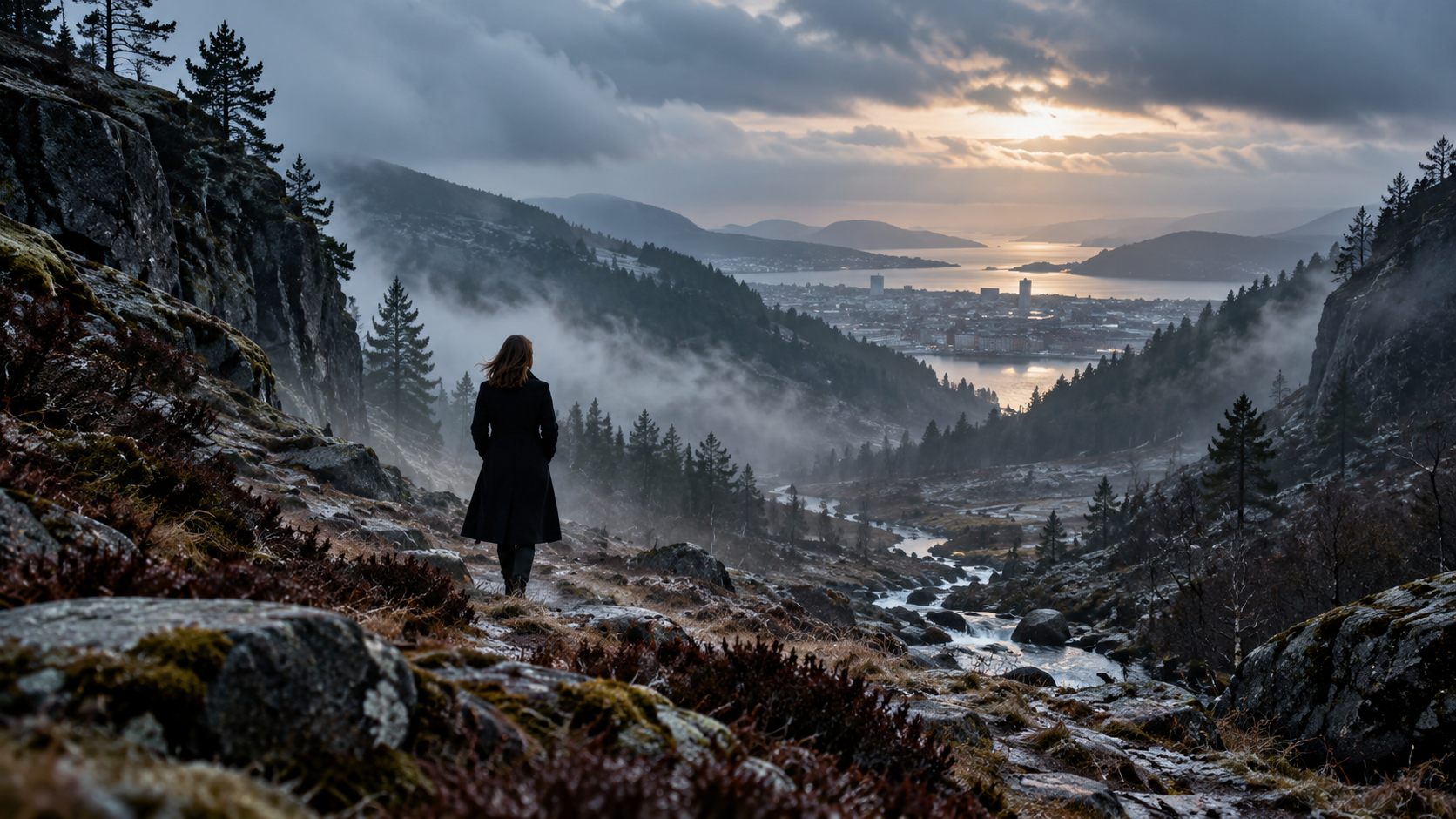
False identities, wigs, coded messages and a mysterious death in the mountains above Bergen. More than half a century later, one of Norway’s greatest mysteries remains unsolved.
Norway is generally a rather reassuring country. Parents leave their babies sleeping outside cafés, mountains come with clearly marked hiking trails, and the most suspicious thing about your hotel stay is usually the price of a beer.
But occasionally, Norway produces a story that makes Nordic noir look like a documentary.
On 29 November 1970, a woman was found dead in a secluded valley near Bergen. She carried no identification, identifying markings had been removed from her belongings, and investigators would eventually discover that she had travelled under at least eight different names.
She became known as the Isdal Woman – and nobody has yet established who she really was.
On that November morning in 1970, a man and his two daughters were hiking in Isdalen, a valley in the mountains surrounding Bergen, when they discovered the badly burned body of a woman.
Isdalen translates as Ice Valley. Even the location sounded as though it had been selected by a Scandinavian crime novelist.
Police found personal belongings and clothing, but identifying labels and markings had been removed.
Someone had apparently gone to considerable trouble to make identification difficult.
And things were about to become considerably stranger.
On 2 December 1970, investigators discovered two suitcases belonging to the woman at Bergen railway station.
Among their contents were:
Not exactly what the average tourist packs for a weekend in Bergen.
Hotel records revealed that the woman had travelled extensively, visiting Oslo, Trondheim, Stavanger and Bergen, among other destinations.
She used at least eight different names, frequently presented herself as Belgian and often paid in cash.
She was remembered by hotel employees as elegant, well dressed and rather reserved.
Today, hotel loyalty programmes encourage guests to use the same identity everywhere. The Isdal Woman clearly had a different approach to international travel.
The combinations of letters and numbers initially looked like something an intelligence agency might be interested in.
However, investigators eventually discovered that the entries largely corresponded to dates and destinations, including Paris, Stavanger and Bergen.
It was essentially a coded travel itinerary.
As travel professionals, we appreciate a well-organised itinerary. Although we generally recommend using actual city names.
The discovery helped police reconstruct some of her journeys, but it did little to explain why she was concealing her identity.
The year was 1970, and Norway occupied a strategically important position on NATO’s northern flank.
Against this backdrop, an unidentified woman travelling under false names, carrying wigs, using coded notes and concealing her background naturally attracted speculation about espionage.
Had Ian Fleming written the story, nobody would have questioned the plot.
But there is one rather important problem with the theory: nobody has proved it.
No publicly verified evidence has established that the Isdal Woman worked for an intelligence agency. She may have been hiding from someone or attempting to escape her past.
The espionage theory remains fascinating, but it remains a theory.
The original forensic examination identified sleeping medication, carbon monoxide poisoning and burns as important factors in her death.
Norwegian police concluded that suicide was the most likely explanation. However, the precise circumstances surrounding her death were never fully established.
Why had she concealed her identity? Why had she used so many different names? Could another person have been involved?
None of these questions proves murder, but they explain why the case has continued to attract attention.
On 5 February 1971, just over two months after her body was discovered, the Isdal Woman was buried in an unmarked grave at Møllendal Cemetery in Bergen.
She was given a Catholic funeral and buried in a zinc-lined coffin to help preserve her remains should she ever be identified.
No relatives were known to investigators.
In 2016, Norwegian broadcaster NRK began revisiting the mystery, taking advantage of forensic technology unavailable to investigators in 1970.
Scientists examined chemical signatures preserved in the woman’s teeth using isotope analysis.
According to research published by the Geological Survey of Norway, the findings suggested that she:
Further forensic research published in 2021 produced an estimated birth year of 1932, although her exact age remains uncertain.
It turns out that your teeth can remember things about your childhood that you have long forgotten.
Investigators also succeeded in developing a DNA profile from preserved biological material.
In 2018, NRK and the BBC World Service launched the investigative podcast Death in Ice Valley, bringing the mystery to an international audience.
New technology. New evidence. New theories.
Still no confirmed identity.
Twenty-five years later, Norway experienced another remarkably similar mystery.
On 3 June 1995, a woman registered under the name Jennifer Fergate was found dead in room 2805 of Oslo’s Plaza Hotel.
Her identity could not be established, her personal details were false, and identifying labels had been removed from some of her clothing.
Like the Isdal Woman, she had claimed to be Belgian.
And once again, speculation about espionage followed.
Interestingly, isotope analysis was later used in both investigations to explore the women’s geographical origins.
We explore this equally fascinating case in our story, The Oslo Plaza Mystery: The Woman Who Never Existed.
Two mysterious women. Two Norwegian cities. Twenty-five years apart.
The similarities are extraordinary, although no evidence has established a direct connection between the two cases.
Fortunately, Bergen is considerably better known for its colourful waterfront, seven surrounding mountains and spectacular fjord landscapes.
Visitors can explore the UNESCO-listed Bryggen district, ride the Fløibanen funicular – featured in our guide to the top attractions in the Nordic countries – or continue into Norway’s magnificent fjord country aboard the Flåm Railway.
Bergen is also famous for its generous supply of rain. Occasionally, the sun makes a guest appearance.
Isdalen itself is a real valley rather than a fictional setting created for a Scandinavian crime drama. However, the discovery site is not a conventional tourist attraction, and its sensitive history deserves respect.
As of November 2026, no confirmed identification has been made public.
More than half a century after her death, investigators have reconstructed parts of her travels, examined her belongings, deciphered her notes, analysed her teeth and developed a DNA profile.
They have discovered where she may have grown up and approximately when she was born.
Yet the most basic question remains unanswered.
Who was the Isdal Woman?
Behind the theories of espionage, false identities and international intrigue was a real person.
Somewhere, perhaps, there was once a family or a friend who knew her by an entirely different name.
And who never discovered what happened to her.
The Nordic countries offer considerably more than fjords, Vikings, Northern Lights and exceptionally expensive alcohol.
Behind their spectacular landscapes lie remarkable histories, unusual traditions and extraordinary stories that even the most imaginative fiction writers would struggle to invent.
At Best of Nordic, we help travel professionals discover the destinations behind these stories through tailor-made group journeys, corporate events, incentive programmes and educational visits.
Explore more fascinating discoveries in our Best of Nordic Stories.